

Flu influenza : We all pretend we know the flu, but the truth is that it is a different kind of a beast. The first day you are perfectly fine and then the next it’s like your body is absolutely not cooperating: fever, aching, fatigue, just the total shutdown. You don’t have control over it and you can’t resist it.
People around me have had it, friends, family members, coworkers and all of them had no idea till the moment they totally crashed that it is much more than “a bad cold.” Once, having gone through flu, you would never try to compare the two diseases again.
That’s why I would like to talk about flu influenza without exaggerating or using complicated medical terms, only very straightforward and down-to-earth explanation.
Table of Contents
What Is Flu Influenza, Really? (Not Only “A Bad Cold”)
Flu influenza is a highly contagious viral disease that severely affects the respiratory system. This basically means that your lungs as well as your nose and your throat are the areas where the infection spreads. The culprit here is the influenza virus and not the viruses that cause your stomach to get upset.
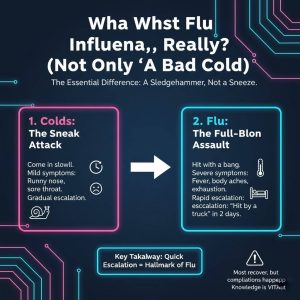
Here’s the essential difference.
- Colds sneak in slowly.
- The flu comes in with a bang.
At first, you’re feeling good and within two days time, you feel as if you got hit by a truck. That very quick escalation is one of the main symptoms of flu influenza.
Most people get better without medical help. Nevertheless, occasionally flu may be the reason for health complications. This is the reason why knowledge about it is important.
What Makes Flu Influenza Virus Persist (And Why Do We Keep Getting It)
Viruses are so clever and deceitful. Influenza viruses don’t just get changed, they keep changing. You can almost bet that every year a new strain will be there. The same is true for the flu vaccines, which is why they get changed yearly too.
The spread of the flu influenza takes place by means of very small droplets. A person coughs, sneezes and talks. You breathe their droplets in. Or you take a touch of their hands wash your face afterward.
In the words of my personal experience, the most frightening thing is how effortlessly it spreads among people. Just one sick colleague in an office can easily spread an infection to half of the team within the next few days.
Flu Influenza Symptoms That Can Surprise You
That is when it hits home really hard.
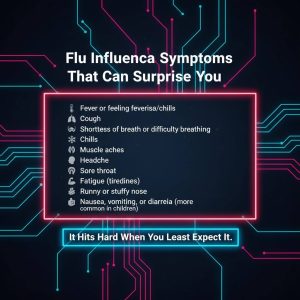
The list of symptoms normally comprises:
- Fever or feeling feverish/chills
- Cough
- Shortness of breath or difficulty breathing
- Chills
- Muscle aches
- Headache
- Sore throat
- Fatigue (tiredness)
- Runny or stuffy nose
- Nausea, vomiting, or diarrhea (more common in children)
Sometimes it even happens that kids don’t show typical symptoms, but just seem fussy, vomit or complain about ear pain. Some even get diarrhea that surprises many parents.
To me, it is the extreme frailty that speaks loudest. With flu influenza, even the simple things like getting up from the bed are as if you run a marathon.
Signs of Flu Influenza Emergency Nature (Recognize These)
Generally, cases of flu influenza are very much manageable at one’s own home. Nevertheless, there are some red flags which should never be ignored.
Adults:
- Difficulty in breathing or shortness of breath
- Persistent pain or pressure in the chest or abdomen
- Sudden dizziness, confusion, inability to wake or stay awake
- Severe or persistent vomiting
- Flu symptoms improve but then return with fever and worse cough
- High-risk groups for flu complications and up to date with flu vaccine
Children:
- Trouble breathing
- Chest pain or severe cough
- Not drinking enough fluids and signs of dehydration
- Flu symptoms improve but then return with fever and worse cough
- High-risk groups for flu complications and up to date with flu vaccine
Getting medical assistance is an absolute must if you notice these signs. Its flu influenza, complications that take people by surprise, fast flu influenza complications move faster than people expect.
How Flu Influenza Virus Compact Is in One Breath
Flu viruses remain airborne for only a brief period. They can be found on materials and surfaces. They can even be transmitted during the incubation period or when the person’s asymptomatic.
One can be the source of the infection:
- 1 day before symptoms
- 5 to 7 days after getting sick
Children and people with weakened immune systems may be infectious for a longer period.
This is when the explanation of the fact that flu influenza spreads rapidly in schools, offices, and on public transport becomes very clear.
A Person Who Has a Higher Than Average Chance of Contracting Illness Due to Flu Influenza
There are certain individuals who are exposed to much greater risks. This part is quite significant.
People with such conditions are very susceptible:
- Children younger than 5 years old, especially less than 2 years old
- Adults aged 65 years and older
- Pregnant women and those up to 2 weeks postpartum
- American Indians and Alaska Natives
- Residents of nursing homes and other long-term care facilities
- People with asthma, neurological and neurodevelopmental disorders
- Children with conditions like tracheomalacia, seizures, or intellectual disabilities
It’s often amusing to me how frequently perfectly healthy grown-ups downplay their risk of getting sick. Flu influenza does not discriminate. It only that it affects the weakest ones much more severely.
People Becoming Victims Of Flu Influenza And Then Developing Severe Cases
Most people get better by around 1 or 2 weeks after they get sick. Nevertheless, some of the time there may be complications as well.
These complications are:
- Pneumonia
- Bronchitis
- Sinus infections
- Ear infections
- Worsening of chronic medical conditions, such as congestive heart failure, asthma, or diabetes
- Rarely, inflammation of the heart, brain, or muscle tissues
It is pretty evident that flu influenza should be taken seriously and not something one can just “power through” without taking care of yourself.
The Truth That Remains Behind Flu Influenza Vaccines (How Vaccines Are Useful Without Being Always Fully Effective)
Flu shots are often said to protect us from getting sick in the first place. The truth is they do not give such a guarantee. What they indeed do is they reduce the risk of an individual becoming severely ill after getting infected.
Here is what you can get from immunization:
- Decrease the number of doctor visits
- Lower the risk of hospitalization for flu, and flu-related complications
- Reduce the severity of illness in people who get vaccinated but still get sick
The influenza vaccines for the year 2025-2026 are aimed at targeting three different and widely spread strains of influenza viruses. It is going to be given either through an injection, nasal spray, or jet injector.
Based on my observations, those who decide against taking vaccines often end up regretting their choice once the flu influenza starts spreading like wildfire.
Simple Ways to Prevent Flu Influenza (That Actually Work)
These measures may seem dull but they are very effective.
– Wash your hands regularly, at least for 20 seconds with soap and water. If soap is not available, use an alcohol-based hand rub. – Avoid touching your eyes, nose, and mouth. – Stay home when you are sick. – Cover your mouth and nose with your elbow or tissue when you cough or sneeze. – Clean and disinfect frequently touched objects and surfaces. – Get an annual flu vaccine.
Just imagine how much flu influenza would slow down if everyone would only follow half of these tips.
Why You Should Care About Flu Influenza Every Year
Flu season comes back every year. It is totally indifferent to your schedule. It also doesn’t wait for the right moment.
Knowing about flu’s influenza can give you an edge to:
– Get vaccinated against the flu every year. – Make good lifestyle choices to strengthen your immune system. – Take flu symptoms seriously and rest. – Avoid infecting others by practicing good hygiene and staying home when sick.
Seeing a person suffer from the flu through only one time makes you remember it forever.

Lessons We Keep Learning From Flu Influenza
The flu keeps on teaching us things:
– We can never take our health for granted. – We need to be more considerate about others’ health. – We get an annual reminder of the importance of vaccination. – There is a great power in adhering to good hygiene habits.
Listening to your body at the first stage of the illness is crucial. This is the only thing, from my experience, that can really save you.
Wrapping Up Flu Influenza (The Honest Takeaway)
Flu’s influenza is everywhere. But it’s not safe to underestimate it. It can be transmitted to many people quickly. It can cause a significant amount of misery. And sometimes, it can also be life-threatening.
Nonetheless, knowledge changes everything. With vaccines, hygiene, and awareness, most people recover safely.
Don’t be afraid of it, just give it the respect it deserves.
FAQs About Flu Influenza
1. What is flu influenza and how is it different from a cold?
Influenza is an infectious respiratory viral disease that can give you a rapid onset of symptoms. It normally causes you to feel more exhausted than a cold would.
2. How long does flu influenza usually last?
Usually, the duration of flu’s influenza is one or two weeks. Though, some symptoms like fatigue may last for a longer period of time.
3. Can flu influenza be dangerous for healthy adults?
Of course, complications are rare but even a healthy adult can catch a serious illness due to the flu’s influenza.
4. How does the flu influenza vaccine help?
The vaccine is intended to prevent you from having severe flu symptoms, being hospitalized, or passing away from flu’s influenza.
5. When should I see a doctor for flu influenza symptoms?
You should consult a doctor if you experience severe symptoms, if your condition suddenly becomes worse, or if you belong to a high-risk group.